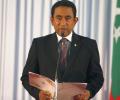
'Of course, Maldives is chicken feed for the Indian armed forces. And an intervention in the Maldives may serve the purpose of creating jingoism in an election year.' 'But from the foreign policy perspective, any such move will be a flagrant violation of international law and the UN Charter,' warns Ambassador M K Bhadrakumar.

When African ambassadors said the attacks against Africans are 'xenophobic and racial in nature,' the MEA declared 'strong Indian institutions are adequate to deal with aberrations that represent an act of a few criminals.' 'This is a lie,' says Aakar Patel. 'India's institutions can't even protect Indians against mob attacks, how will they protect foreigners?'

China on Wednesday said it attaches 'great importance' to Sushma Swaraj's visit to Beijing.
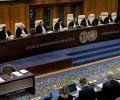
Rubbishing Pakistan's claim of a victory in the case, External Affairs Ministry Spokesperson Raveesh Kumar said Islamabad has its 'own compulsions to lie' to its people.

Commerce Minister Anand Sharma has a tough time in Davos pacifying African leaders, who are extremely upset over Delhi law minister's midnight raid. Anita Katyal reports

India on Thursday wrapped up its air evacuation operations from Yemen rescuing another 630 of its citizens from Sanaa, taking the total number of Indians brought home from the war-ravaged country to over 4,640 besides around 960 nationals from 41 countries.

While the Punjab CM expressed grief, his Congress colleagues targeted Sushma Swaraj for misleading the families.

The uncertainty over Pakistan's participation in the World Twenty20 finally ended on Friday after the country's cricket team received government clearance to travel to India following assurances of security from the host nation.

'People feel concerned about the future, whether it is the land or the jobs.' 'The BJP came to power in Assam with promises of maati, bheti (home, hearth and identity), land, jobs and culture.' 'Are these going to taken care of? I think those are real concerns.' 'The Assam chief minister (Sarbananda Sonowal) was one of the leaders of the All Assam Students Union which fought for and is one of the signatories to the Assam Accord.' 'Today, his comrade-in-arms (Samujjal Bhattacharya, chief advisor, AASU) is leading the opposition in the streets.'

Modi's arrival has changed the optics of the visit. There is a different demonstration of the confidence level in the Indian leadership, but not much has changed beyond that, reports Sheela Bhatt/Rediff.com.
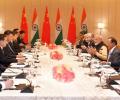
The prime minister started off his remarks at the meeting in Tamil, welcoming China to the talks, which were held right after one-on-one discussions between Modi and Xi at the Taj Fisherman's Cove Hotel.

Breaking his silence, Finance Minister Arun Jaitley on Tuesday came out in strong defence of External Affairs Minister Sushma Swaraj in the 'Modigate' saying she acted "bona fide" and with "good intentions" and the entire government and party were one on the issue.

Weeks after 'breakthrough', substantial work is yet to be done

The Chinese envoy said that the India-China bilateral ties can't take the strain of another Doklam episode

Official talks were held between Modi and Seikh Tamim for multi-sectoral partnership and strengthening of Indo-Qatar ties following which the agreements and Memorandums of Understanding were signed on the second day of the Prime Minister's visit.

At the event, Minister of State for External Affairs V K Singh denied that the attack on the Congolese Masonda Ketada Oliver was a racial one and hoped that such incidents will not ecur.

Breaking the logjam in their ties, India and Pakistan on Wednesday announced that they have decided to engage in a "comprehensive" dialogue that will include peace and security and Jammu and Kashmir.

As Prime Minister Narendra Modi reached the White House for the private dinner hosted by President Barack Obama, India and the US on Monday issued a vision statement "Chalein Saath Saath: Forward Together We Go" that called for a joint endeavour for prosperity and peace.

Terming the Khobragade episode "extremely irksome", Union External Affairs Minister Salman Khurshid on Sunday said it was time there should be a "closure" to the issue for which the US should find a "political solution".

India on Monday got the backing of Switzerland in its bid to become a member of the Nuclear Suppliers Group.

'Significantly, Foreign Secretary Gokhale was received at very high level in Beijing.' 'It only shows China's keenness to move forward and put the relationship on a 'win-win' footing,' says Ambassador M K Bhadrakumar.

'Problems will keep recurring unless China vows to resolve all outstanding issues between the two sides,' says Sana Hashmi.
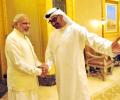
Apart from key bilateral issues, the two leaders also discussed situation in the region, particularly in wake of the increasing threat of terrorism and extremism from various sources including the Islamic State militant group.

'Look East' policy was first coined by the Narasimha Rao government in the 1990s and has been followed by the successive governments.

India and China on Friday agreed to seek a "political" solution to the border dispute at the earliest as Prime Minister Narendra Modi asked Beijing to "reconsider its approach on some issues" and announced CBMs like e-visa for Chinese tourists and operationalisation of hotline between two militaries.

'It is a pattern of behaviour of the Chinese that whenever a Chinese leader visits India or an Indian leader visits China, some incidents take place.' 'When Modi visits China, we should look out for some similar demonstration by the Chinese.'

'While China expressed reservations on the Indian role in the South China Sea, Beijing threw to the winds Indian concerns on Kashmir by announcing $46 billion in investments Pakistan occupied Kashmir,' says Srikanth Kondapalli.

Former Defence Minister A K Antony on Wednesday acknowledged "corruption" in the AgustaWestland chopper deal.

Before the 2014 Lok Sabha elections, Modi had criticised Manmohan Singh's policy towards China and promised a more strong-willed policy. Those claims are now under a cloud.

'If, as appears to be the case, India is on way to 'mending fences' with China, and China is equally desirous to 'reset' the relationship, this could be a self-reflexive moment in India's positioning vis-a-vis not just the Dalai Lama, but also the Tibetan issue and China as a whole,' points out China expert Alka Acharya.

Prime Minister Narendra Modi on Sunday discovered a "special connection" with Mongolia when he entered the Buddhist country's Parliament to deliver a speech, the first foreign leader to do so on Sunday -- a holiday.

Abbas seeks India's role in peace process as PM Modi visits Palestine.

Pak seeks US help to ease tensions with India.

After visiting two Central Asian countries, Prime Minister Narendra Modi arrived in Ufa on Wednesday on a three-day trip during which he will attend the BRICS and Shanghai Cooperation Organisation summits.
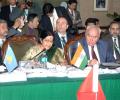
'The truly amazing part is the influence that Washington wields over Modi and the Sangh Parivar,' says M K Bhadrakumar. 'What explains it? The Americans know precisely well which raw nerve to touch and how to make the Sangh Parivar, Modi and this government perform the trapeze act.'

'How can a State, which claims to be a responsible power, unilaterally grab a "disputed" area to build a road on it?' asks Claude Arpi.

'We have petitioned the district collector and MEA to put pressure on the Saudis for compensation, but nothing has happened.' A Ganesh Nadar reports on the family's plight.

BJP general secretary Ram Madhav said the two neighbours needed to inject informality in their relations, as is the case in many places of the world like the EU and ASEAN.
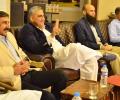
'Over the last year, Bajwa has created the environment to support bold moves on India. The ball is in India's court,' a senior Pakistan military officer tells Ajai Shukla.
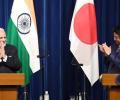
'Relations between India and Japan are robust and devoid of either shadow of history or any irritant.' 'In fact, there is plenty of warmth and goodwill earned over history. There are no negatives but only opportunities,' notes Dr Rajaram Panda.
